
 For decades, clinical research has been constrained by a familiar challenge: finding the right patients at the right time and keeping them engaged throughout the study.
Despite billions invested in drug development, nearly 80% of clinical trials experience delays due to recruitment challenges, while participant dropout continues to impact timelines, costs, and data quality. Traditional site-centric models are simply not designed for the connected, digital world we now live in.
Today, a quiet transformation is underway. The convergence of Real-World Evidence (RWE), artificial intelligence, electronic health records, wearable devices, and decentralised clinical trial technologies is fundamentally changing how studies are designed, managed, and executed.
The question is no longer “How do we recruit patients?”
It is now:
“How do we identify, engage, retain, and continuously learn from patients throughout their healthcare journey?”
From Recruitment to Continuous Engagement
Historically, patient recruitment relied on investigator databases, physician referrals, and advertising.
Modern digital platforms are enabling something far more powerful:
- Integration with real-world healthcare data
- Digital pre-screening
- Remote consent
- Continuous patient engagement
- Real-time outcome collection
- Hybrid and decentralised study participation
Research increasingly shows that digital approaches can significantly broaden participant reach, while long-term retention improves when technology is combined with meaningful clinician engagement rather than replacing it.
This shift is transforming clinical trials from isolated research events into an extension of routine healthcare.
Why Real-World Evidence Matters
Regulators, healthcare systems, and pharmaceutical companies are increasingly looking beyond traditional randomised controlled trials.
Real-World Evidence provides insight into:
- How therapies perform outside controlled environments
- Long-term safety
- Treatment adherence
- Patient-reported outcomes
- Healthcare utilisation
- Diverse patient populations often underrepresented in traditional trials
When integrated with clinical research, RWE doesn’t replace randomised trials; it complements them, making evidence generation faster, richer, and more representative of real clinical practice.
Introducing AMDiris: Reimagining Clinical Research
At Alpha MD, we believe the future of research lies in connected digital ecosystems.
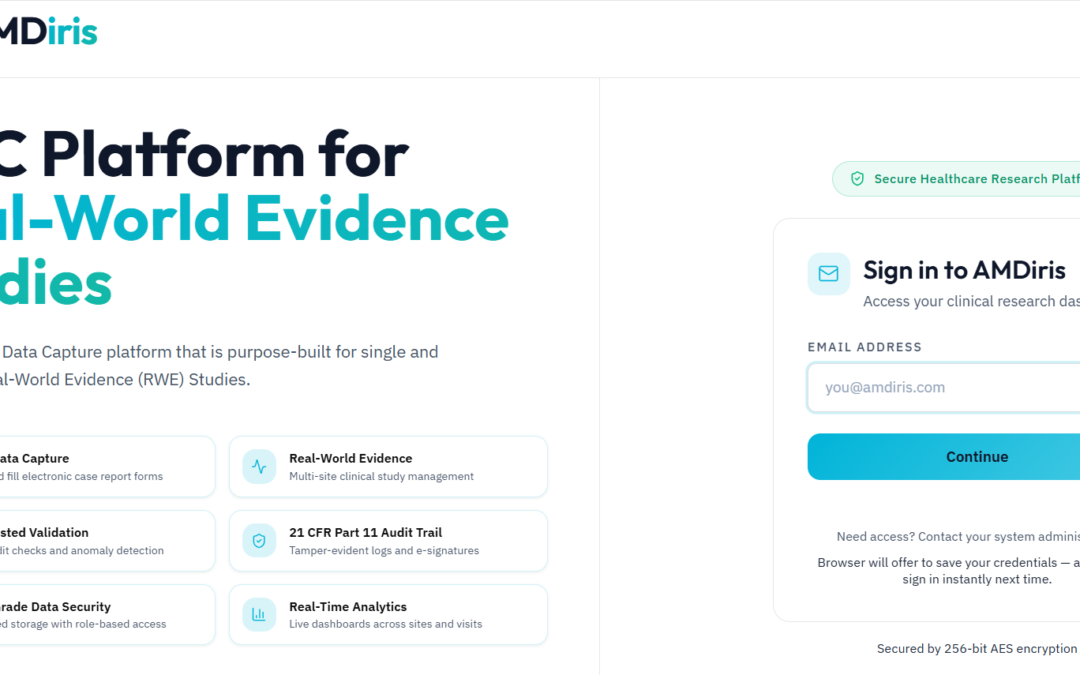
That belief led us to build AMDiris, our next-generation digital platform designed to simplify and accelerate every stage of clinical research.
Rather than functioning as another standalone trial management system, AMDiris creates a unified ecosystem connecting sponsors, CROs, healthcare providers, investigators, and patients.
Its vision is simple:
- Identify eligible participants earlier
- Reduce recruitment timelines
- Improve participant engagement
- Enhance retention throughout the study
- Capture high-quality real-world evidence
- Enable hybrid and decentralised trial models
- Deliver meaningful insights through intelligent analytics
By bringing together patient engagement, digital workflows, and real-world data, AMDiris helps transform fragmented research processes into connected experiences.
The Human Element Still Matters
Technology alone will never solve recruitment.
Patients participate because they trust their physicians.
They remain in studies because they feel supported.
Digital platforms should strengthen these human relationships and not replace them.
The most successful future clinical trials will combine AI-driven efficiency with compassionate patient engagement.
That is where true innovation happens.
Looking Ahead
Clinical research is entering one of its most exciting decades.
The organisations that succeed won’t necessarily be those with the largest investigator networks.
They will be those that build the strongest digital ecosystems; connecting healthcare, patients, and evidence in ways we’ve never seen before.
At Alpha MD, we are proud to be contributing to that future through AMDiris.
Because the future of clinical research is no longer about where patients come for research.
It’s about bringing research closer to where patients already live, receive care, and generate real-world health data.
The next breakthrough in medicine may not come from a laboratory alone.
It may come from a connected digital ecosystem that finally makes clinical research accessible, inclusive, and truly patient-centric.